
Your Journey with James Alexander
Quality & Craftsmanship
Creating an extension involves a number of stages, from the first ideas and design work through planning, manufacture and installation. We guide the project through each stage, keeping the process clear and making sure the finished building reflects both the house and the way you want to use it.
From the very first conversation to the moment you step inside your finished space, we're with you every step of the way.
-
Every project begins with a complimentary consultation at your home. This gives us the opportunity to understand the property, see how the existing spaces work and talk through what you would like the extension to change.
We will discuss your ideas, priorities and the way you want to use the new space, while also considering the architecture of the house and any practical or planning constraints that may influence the design.
Exploring the possibilities. We can use photographs, previous projects and drawings to help illustrate different approaches and begin establishing what may work for your home.
Developing the brief. The conversation forms the starting point for the design, allowing us to develop a proposal around your particular house rather than adapting a standard design.
Already have drawings? If you already have architectural drawings or an established design, we can review these and develop the timber structure accordingly.
-
Once the brief is established, the design begins to take shape. Our team develops the building in-house, considering its proportions, roof form, glazing, doors, joinery and relationship with the existing house.
Detailed drawings and 3D modelling allow you to understand the proposal properly before manufacture begins and give us the information needed to coordinate the technical stages of the project.
3D design. The proposed building can be viewed in three dimensions, helping you understand its scale, form and relationship with your home.
Design development. The proposal is refined with you as the details are resolved, so there is time to consider the elements that matter before the design is finalised.
Independent structural engineering. The buildings are designed in-house and independently structurally engineered, giving the manufacture and installation team the technical information required for the finished structure.
-
Where planning permission or other approvals are required, James Alexander can manage the process as part of the project. This includes preparing the relevant drawings and applications and liaising with the appropriate authorities as the design progresses.
Planning applications. We prepare and submit the drawings and information required for the planning application and liaise with the local planning authority where necessary.
Listed buildings and protected areas. Where a property is listed, within a Conservation Area or affected by another designation, the additional requirements can be considered from the outset and the appropriate applications prepared.
Building Regulations. We prepare the Building Regulations drawings and applications and coordinate the structural calculations required for the James Alexander building.
Keeping these stages connected to the design helps ensure that planning, technical development and manufacture are working from the same information.
-
Once the design, approvals and technical information are in place, the timber structure can move into manufacture.
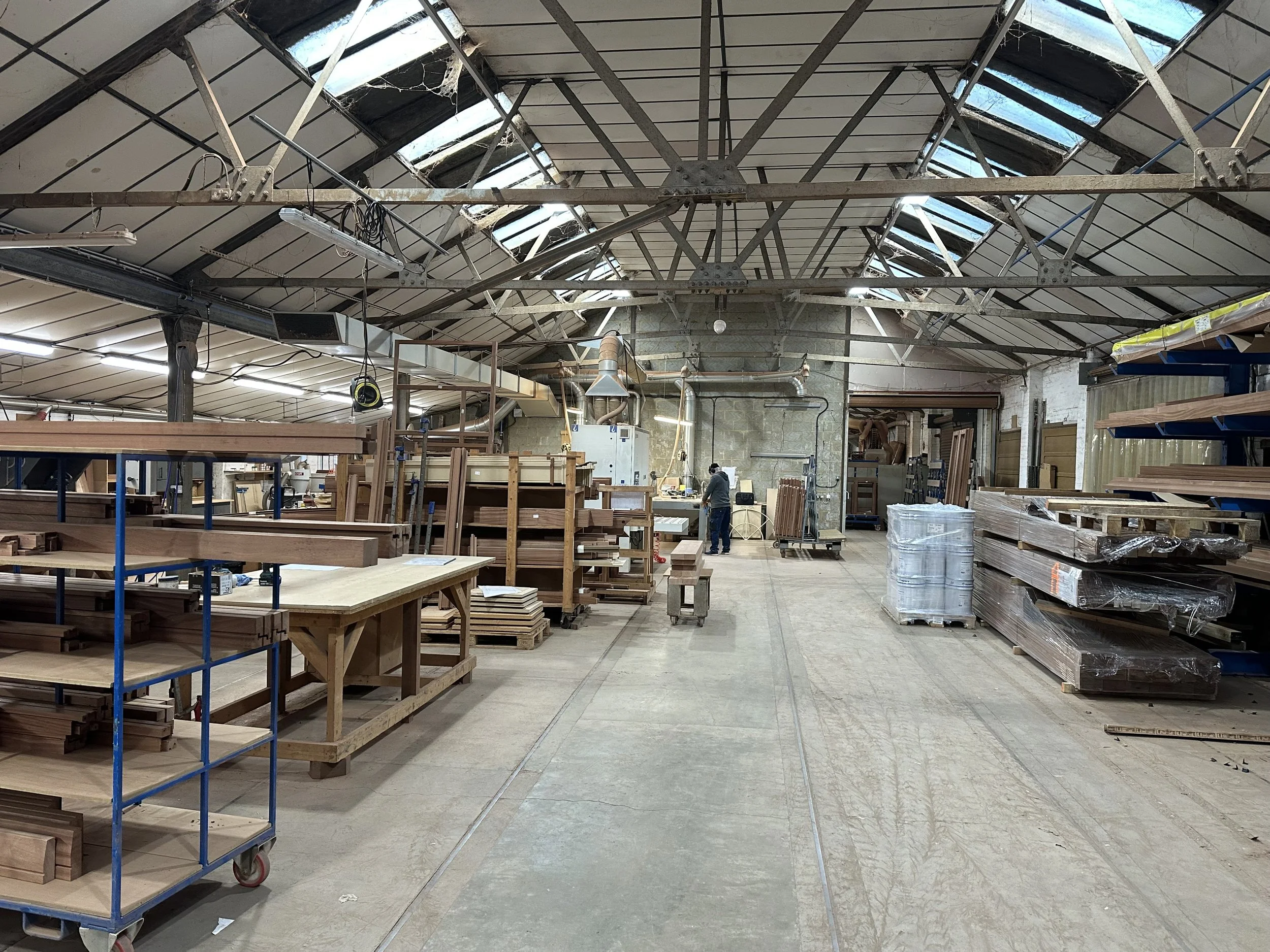
James Alexander works alongside an established specialist manufacturing facility in Milton Keynes, where the joinery is produced to the drawings and specification developed for your project.
The components are manufactured and finished in a controlled workshop environment before being prepared for installation on site.
-
While the timber structure is being manufactured, the foundations and base can be prepared on site by your chosen contractor.
Technical information. We provide the drawings and information required for the groundworks so that the contractor can prepare the base to suit the James Alexander building.
Pre-installation checks. Before installation begins, the completed base is checked so that any issues can be identified before the timber structure arrives on site.
We remain available to liaise with you and your contractor throughout this stage, helping the transition from groundworks to installation run smoothly.
-
Once the foundations are ready and the timber structure has been manufactured, the James Alexander installation team brings the building together on site.
The frame is erected, followed by the glazing, doors, roof elements and associated joinery that form the completed structure. The drawings and technical information developed earlier in the project guide the installation throughout.
With much of the joinery prepared and finished before it arrives on site, the installation can be carefully coordinated around the existing property.
-
As installation reaches completion, the building is checked and the final details are finished before it is handed over to you.
Our customers are consistently amazed by how closely the finished building mirrors the original 3D model and by how quickly it begins to feel like it was always part of the home.
James Alexander's painted timber extensions are covered by the 10-year warranty on the main timber structure and James Alexander joinery workmanship, with separate five-year cover applying to hardware, paint coatings and glazing seals, subject to the terms and conditions of the warranty.
Your Journey With Us
Our Guarantee
Our relationship with you doesn’t end when the build is complete. As a small family-run business, we remain available after installation and take real pride in the buildings we create and the relationships we build with our clients.
The Sapele Standard
Why We Use Hardwood (When Others Don't)
Most garden rooms look great the day they are finished. But at James Alexander, we build for how your room will look in ten, twenty, and thirty years.
That’s why we are one of the few specialists to use Sapele Hardwood for all our painted timber sections.
The Problem with "Standard" Softwood
Many competitors use softwoods like Pine or Spruce. While cheaper, these woods are "active"—they breathe, twist, and resin "bleeds" through the paint. This leads to sticking doors, cracked paint finishes, and eventually, rot.
The James Alexander Difference: Sapele Hardwood
Sapele is a premium African hardwood, traditionally used in luxury boat building and fine musical instruments. Here is why we insist on it:
A "Furniture Grade" Finish: Sapele is a closed-grain wood with no loose knots. This provides a glass-smooth surface for our paint, ensuring a flawless finish that won't "ghost" or peel.
Rock-Solid Stability: Thanks to its unique interlocked grain, Sapele doesn't warp or swell like cheaper timbers. Your windows and doors will open as smoothly in a damp January as they do in a dry July.
Naturally Rot-Resistant: Sapele is packed with natural oils that repel insects and decay. It is twice as dense as Cedar and four times harder than Pine, making it a "lifetime" timber.
When you choose a James Alexander garden room, you aren't just buying a building; you’re investing in the structural integrity of genuine hardwood.
-
While Western Red Cedar is popular for its color, it is actually a very soft wood that dents easily and can be difficult to paint effectively. Pine and Spruce are "active" softwoods that expand and contract significantly with the British weather. We use Sapele because it offers the perfect balance of density, stability, and a furniture-grade paint finish that softwoods simply cannot match.
-
Paint typically peels on softwood because the wood underneath "moves" or because resin from knots pushes the paint off. Because Sapele is incredibly stable and knot-free, the bond between our microporous paint and the timber is far superior. This results in a finish that lasts significantly longer before requiring a top-coat refresh.
-
Yes. We ensure our Sapele is sourced from FSC or PEFC-certified forests, meaning it is harvested responsibly with a focus on long-term forest health and biodiversity. Because a Sapele building lasts decades longer than a softwood one, it is also a more sustainable "long-term" choice for the planet.
Sapele isn't just "better"; it’s a different class of material entirely.
Hardness (The Drip/Dent Test): Sapele has a Janka Hardness rating of approx. 1,510 lbf. Compare that to standard Pine (approx. 420 lbf) or Western Red Cedar (320 lbf). Sapele is nearly 4 times harder than the softwoods often used in garden buildings, meaning it won't dent if a lawnmower or bike clips the door frame.
Density: Sapele sits at around 640–670 kg/m³, whereas softwoods average 400–500 kg/m³. This density is why your buildings feel "solid" and provide better natural sound insulation.
Stability (Moisture Movement): Sapele is famous for its interlocked grain. While softwood fibers are straight and prone to "cupping" or twisting when they get wet, Sapele’s fibers are woven together like a rope, making it incredibly stable. This is why your doors won't "stick" in the winter.
Durability Class: Sapele is rated as Class 2 (Durable). Most untreated softwoods are Class 4 or 5 (Slightly to Not Durable).
Why We Use Microporous Teknos Industrial Coatings
The secret to a long-lasting painted finish isn't just the paint—it’s the science of "breathability." Standard retail paints create a plastic-like film over the wood. If any moisture gets behind that film, it gets trapped, causes the wood to swell, and makes the paint flake off.
Our Sapele rooms use a professional-grade Microporous System:
Vapour Permeable: It allows the timber to "breathe," letting internal moisture escape while providing a waterproof barrier against the rain.
UV Shielding: Our coatings contain advanced UV absorbers that nullify the sun's damaging effects, keeping your chosen colour vibrant for years.
No Knot-Bleed: Because Sapele is a premium hardwood, it has no resinous knots. Combined with our anti-stain primers, we guarantee a finish that stays perfectly uniform.
We can colour-match to Farrow & Ball, Little Greene, or RAL colours. Customers love the "boutique" look of these brands, but those specific retail paints aren't actually designed for the rigours of exterior joinery. "We provide the aesthetic of Farrow & Ball, but with the industrial durability of a Teknos hardwood coating system."
The beauty of using Sapele and a professional Teknos/Remmers system is that the maintenance isn't a "chore"—it’s a simple "check-up."
Most softwood buildings require aggressive sanding and repainting every 2–3 years. Because your materials are so stable, a James Alexander room usually only needs a quick wash and a simple top-coat refresh once a decade.
TIMBER FRAMES
Explore Our Range
START YOUR JOURNEY TODAY
Ready to Bring Your Vision to Life?
Whether you are at the very beginning of considering an extension or already have drawings prepared, we are happy to talk through your project and explain how James Alexander can help.
Tell us a little about your home, what you would like to change and where the property is located. Alex, Dee or one of the team will then be in touch to discuss the next step.
Contact Us
Fill in the form or give us a call to chat with Alex, Dee, or one of the team today
01823 762176